新闻

Skilton

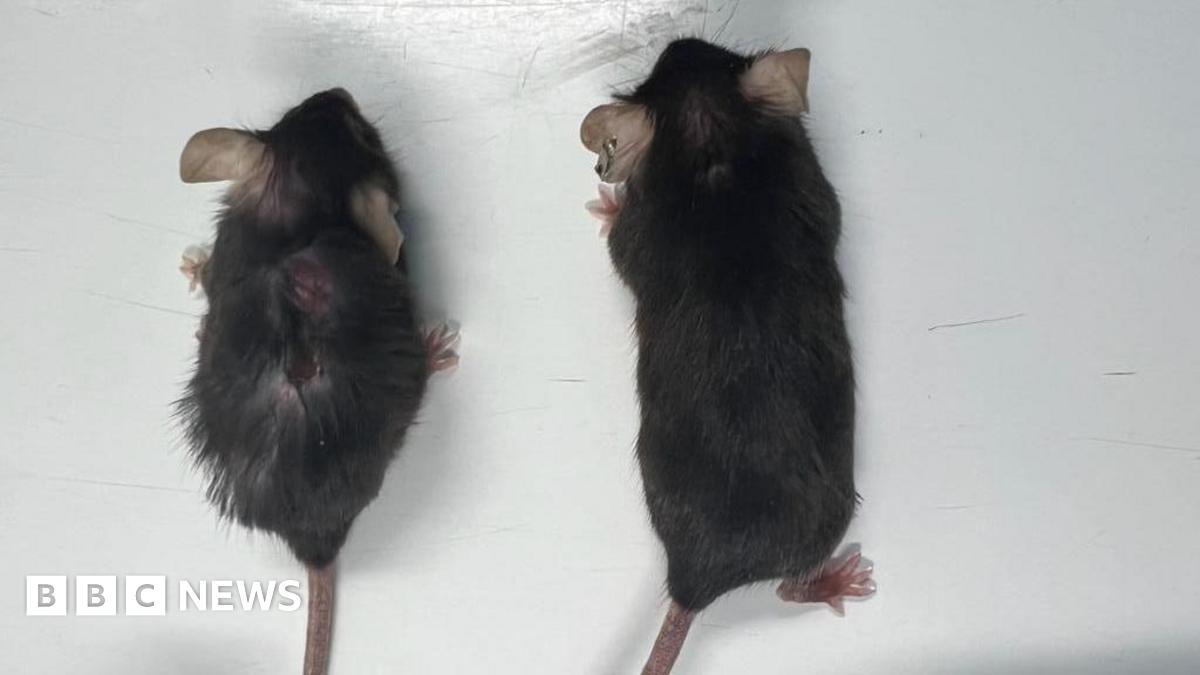
A drug that inhibits inflammation helped mice live longer and reduced the animals’ incidence of cancer and age-related health problems

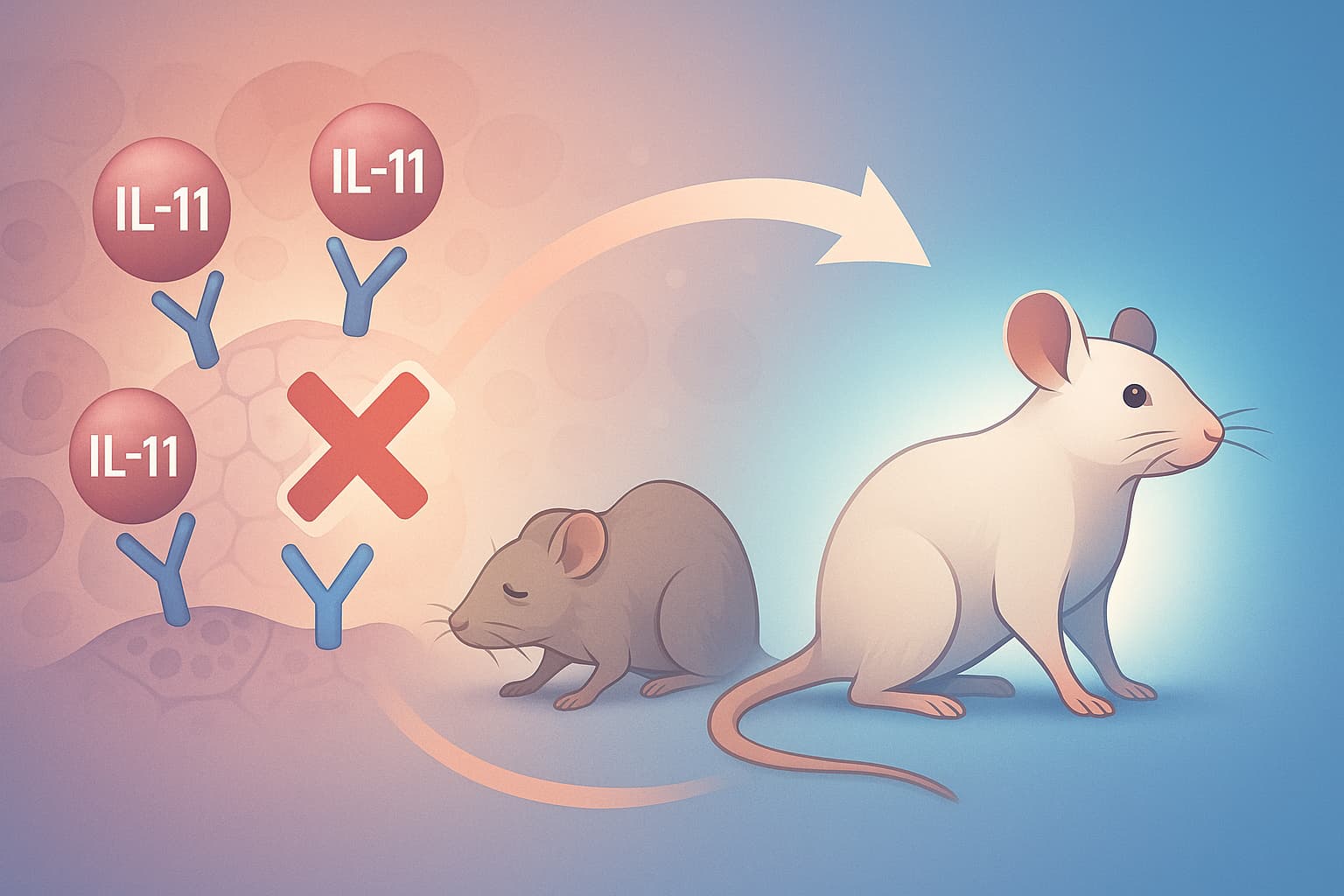
Scientists at the Medical Research Council Laboratory of Medical Science and Imperial College London have discovered that ‘switching off’ a protein called IL-11 can significantly increase the healthy lifespan of mice by almost 25%.

The scientists, working with colleagues at Duke-NUS Medical School in Singapore, tested the effects of IL-11 by creating mice that had the gene producing IL-11 (interleukin 11) deleted. This extended the lives of the mice by over 20% on average.

They also treated 75-week-old mice – equivalent to the age of about 55 years in humans – with an injection of an anti-IL-11 antibody, a drug which stops the effects of the IL-11 in the body.

The results, published in Nature, were dramatic, with mice given the anti-IL-11 drug from 75 weeks of age until death having their median lifespan extended by 22.4% in males and 25% in females. The mice lived for an average of 155 weeks, compared with 120 weeks in untreated mice.

Previously, scientists have posited that IL-11 is an evolutionary hangover in humans, as while it is vital for limb regeneration in some animal species, it is thought to be largely redundant in humans.

However, after about the age of 55 in humans, more IL-11 is produced and past research has linked this to chronic inflammation, fibrosis in organs, disorders of metabolism, muscle wasting (sarcopaenia), frailty, and cardiac fibrosis. These conditions are many of the signs we associate with ageing.

While small doses of inflammation can protect us from disease or injury, excessive amounts damage cells, which is believed to accelerate ageing.

The drug used in this study not only increased lifespan but also reduced cholesterol levels, frailty and body weight in the treated animals, and it improved their muscle strength and metabolism. Together, these findings suggest that blocking IL-11 may minimize age-related health declines in mice as well as improving lifespan.

Few approaches have been shown to robustly increase life span in mice by more than 20%, and now IL-11 inhibition adds to that small selection of interventions. As reported, IL-11 inhibition may work through essentially the same pathways as mTOR inhibition. The degree of life extension is similar to that achieved via mTOR inhibitors such as rapamycin. (from “Fighting Aging”)
RapAdmin

Adam Salmon is getting popular suddenly, as he should be. The longevity outcomes data on rapamycin just keeps getting better! Here is another new interview with Adam brought to us by the Aging Science Podcast of VitaDoa.

Kamil Pabis, a postgraduate student at the National University of Singapore Center for Healthy Longevity, has this to say about his new podcast:

… we discuss the as-of-yet unpublished rapamycin data in marmosets which makes me very optimistic about this longevity drug.

Meet the man who secretly ran the most important rapamycin study you [have almost] never heard of. In this episode of the Aging Science Podcast I interviewed Prof. Adam Salmon. We talked about AMPK, caloric restriction (CR) mimetics and multistress resistance in aging. We also talked about the promise and disappointment with invertebrate models of aging. In the last part of the podcast we discussed the preliminary findings of a marmoset study that is testing whether rapamycin can extend the lifespan of a primate. This is definitely one of the most important ongoing studies in biogerontology. Check out the podcast to learn more.

Short Bio — Prof. Adam Salmon

Adam is a Professor with Tenure in the Barshop Institute and Department of Molecular Medicine at University of Texas Health San Antonio (UTHSA) with a joint appointment as Research Health Scientist in the Southwest Texas Veterans Health Care System. He is also a deputy director for the Interventions Testing Program.

Marmosets ARE a good model of aging

These primates are much longer lived than rodents at an average lifespan of 8–10 years yet not much larger than rats. They die of a much wider range of disease than mice do. Also in contrast to mice they do not constantly graze and are hence less likely to get obese.

Some 10 years ago Adam and colleagues started a study in marmosets to test whether rapamycin will extend their lifespan. The study randomized 66 marmosets and is powered to detect a lifespan difference of 10 to 15%.

Some people have asked why the study uses such a high dose of rapamycin and in response Adam points out that the study was designed before low dose and intermittent rapamycin regimes existed. This explains a lot. As for the choice of animal model? He decided to use marmosets instead of other primates because he could partner with other researchers who already had a large marmoset colony. Setting up a colony by yourself would be prohibitive.

Either way, there is no perfect small primate model. Rhesus monkeys are well studied but too long-lived and expensive. Now this knowledge gap is closing as more people turn towards small primate models like marmosets or mouse lemurs.

No evidence of immunosuppression, lipid and glucose abnormalities even though mTOR signaling was clearly suppressed in these primates. Kidney disease was improved but not epigenetic aging (Horvath et al. 2021) judged by a marmoset clock co-developed with Steve Horvath.

If rapamycin works in marmosets this would be groundbreaking. Check out the podcast for more details and discussion of survival data!

Listen to the full interview at link below:

The discussion about the marmoset rapamycin study begins at the 55 minute mark:

RapAdmin

A little over a year ago I did an interview with Adam Salmon, of UT Southwestern, about the marmoset longevity study they have been doing with rapamycin. I view this as one of the most important and exciting rapamycin longevity studies that is currently in-process because its the first rapamycin longevity study in primates, and the results from this study should be a good proxy for human clinical studies (we seem unlikely to get any human clinical studies funded due to the lack of financial incentive for companies to do one because rapamycin is off-patent, and pharma companies can not make much money off it).

About 15 months after my interview, Adam announced some preliminary results of his study (see earlier post on the 15% median lifespan improvement reported in the marmoset study), but the final results are not yet published.

Prior to talking to Adam I asked our forum members to provide feedback on ideas for specific questions, which you can see in this thread: Do You Have Questions About the Marmoset (monkey) Rapamycin Studies?

Due to my frustration with some of the audio editing tools, and other unrelated delays and priorities, the interview has only now become available. Now that I’ve identified some good audio editing tools and I know how to edit audio files, the turn-around time should be much shorter. I’m not a podcaster, this is the first audio recording of an interview I’ve ever done, but in the interests of not further delaying people’s access to the interview, I’m making it available in an admittedly rough form.

The audio file you can listen to is posted (attached) immediately below in MP3 format, and you can either download and listen to it, or listen to it directly in this message post.

Adam Salmon Interview:

Transcript of interview: here

RapAdmin

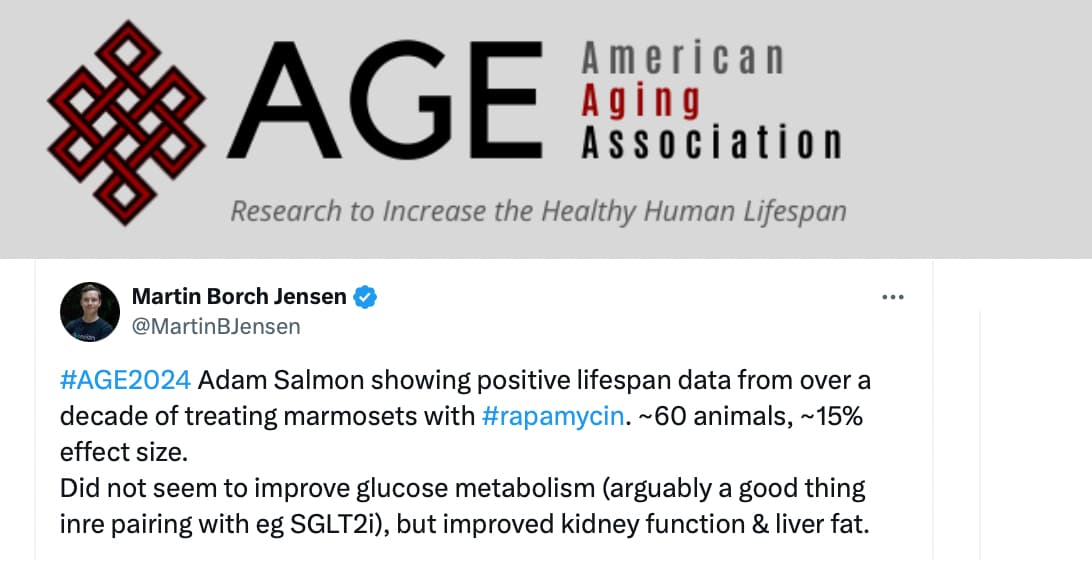
Some very good preliminary news on rapamycin was presented today at the American Aging Association Conference in Wisconsin. This is a groundbreaking development as its the first time we’ve seen primate lifespan improvement with rapamycin (or any other compound TTBOMK) in a well-designed study. It is based on the long-term study of rapamycin-dosed marmosets at UT Southwestern being done in the lab run by Adam Salmon.

This new announcement is important because while rapamycin has been proven effective in lengthening healthy lifespan in every organism its been tested in (including yeast, flies, worms and mice… by dozens of different labs around the world) it has never been tested in primates before for lifespan extension. Some people have questioned whether rapamycin, which has performed so well at lifespan extension in shorter-lived species, would do as well in longer-lived species. This study seems to resolve this question.

The newly announced results (an increase in the median lifespan by approx. 15% for the Rapamycin-dosed marmosets) would seem to be strong evidence that rapamycin works well in primates, and thus there is a very high probability it works similarly well in humans. I’ve contacted Adam Salmon for more information but he says the information presented at this conference is still preliminary so he wasn’t about to give me any survival curve data or other information yet. The research paper covering these results is in process, so we should see more details on the study soon.

The results of rapamycin for healthy longevity increase in primates as reported in this study seem to be generally in line with the mouse studies (which with higher doses get up to the 28% lifespan increase range, and 34% when combined with Acarbose), and also in line with the expectations of many experts in the longevity field, as reported here: 80% of Longevity Experts Predict Significant Benefits for Rapamycin in Humans

The challenge that this news presents to us is that the dosing level and frequency for the marmosets was quite high compared to what we usually dose rapamycin in longevity applications as people are practicing it today. The marmosets received 1mg/kg dosing in their food daily, which given the typical animal to human dosing translations, seems to equate to around 10mg/day for a a 60kg person [Updated; perhaps closer to 30mg every day or two equivalent in humans, per Adam Salmon interview]. Most people in longevity applications right now are dosing around 6mg to 8mg once per week. This new marmoset study suggests that a higher dose may be required for humans to get the same level of benefit, but with higher doses of rapamycin we tend to see higher rates of side effects (diarrhea, gastro-issues, etc.) and if higher doses are taking on a regular basis you typically get some level of immune suppression, and potentially some lipid and blood sugar disregulation; all of which tend to increase health risks in humans. So this may be the key challenge for human translation of this research, how to get higher levels of rapamycin into the blood system, while minimizing the undesirable side effects and risks.

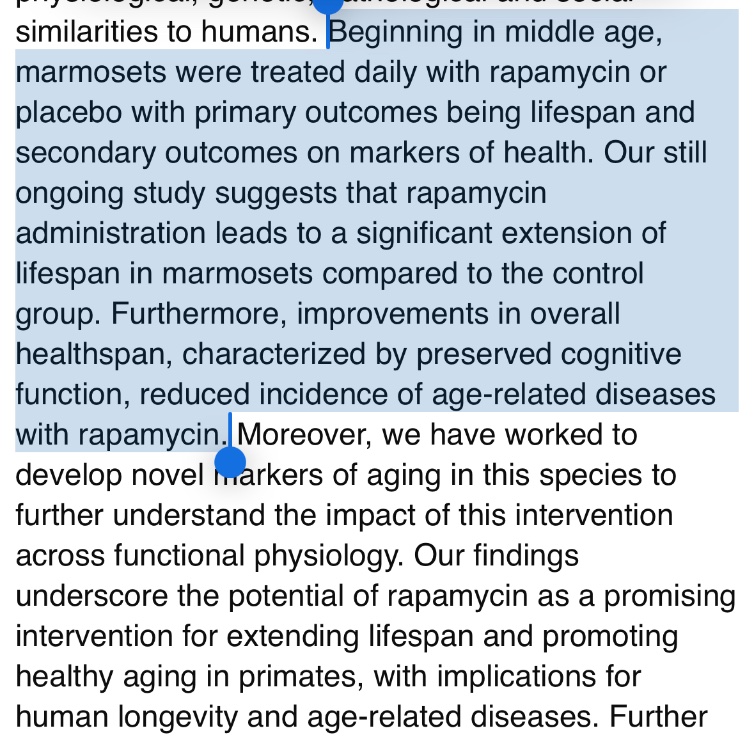
The AmericanAging conference abstract for this talk (Posted on X by David Barzilai):

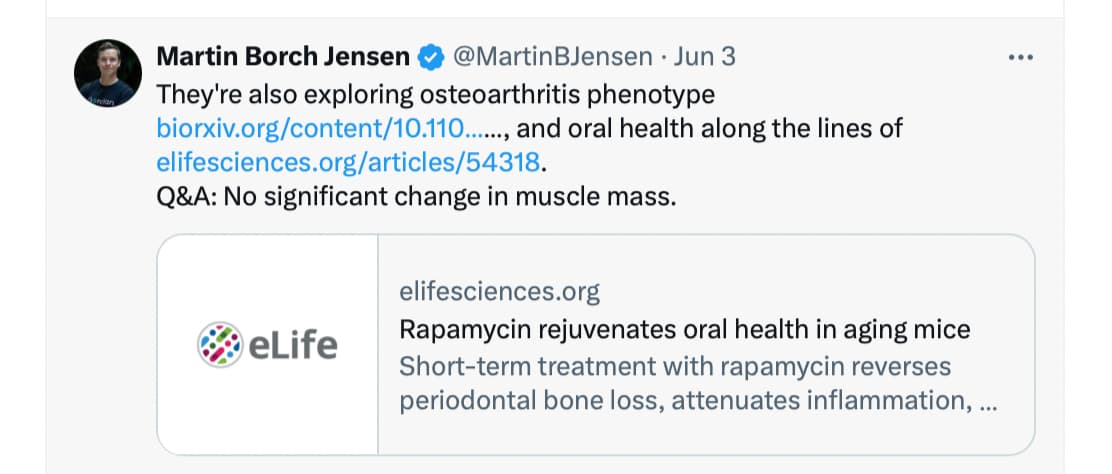
Related reading from Adam Salmon et al: Rapamycin Delays Age-related Osteoarthritis

Related Research: https://www.biorxiv.org/content/10.1101/2024.05.14.594256v1

Related Research: https://elifesciences.org/articles/54318

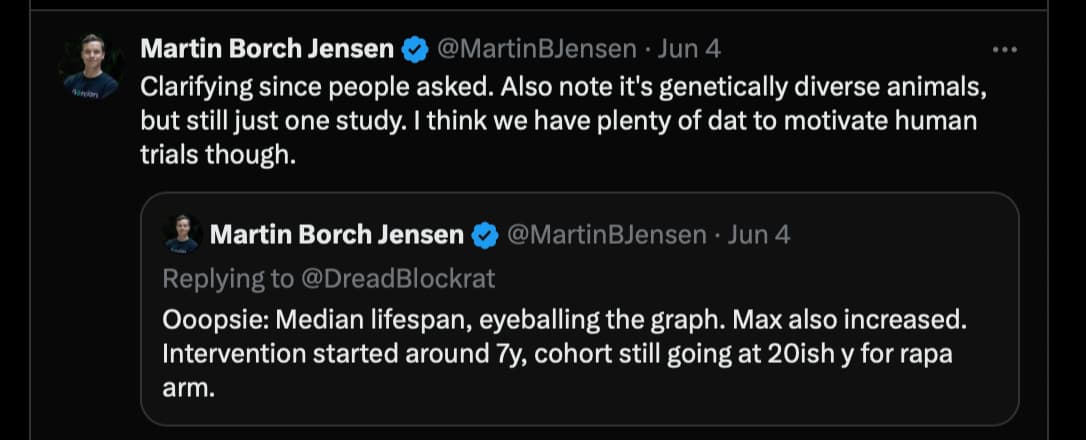
Source: Martin Borch Jensen on X: "#AGE2024 Adam Salmon showing positive lifespan data from over a decade of treating marmosets with #rapamycin. ~60 animals, ~15% effect size. Did not seem to improve glucose metabolism (arguably a good thing inre pairing with eg SGLT2i), but improved kidney function & liv… / X

Read the full Story and Discussion by clicking on the following link: 15% Healthy Lifespan improvement via Rapamycin seen in Marmosets

RapAdmin

Listen to the full podcast at this link:

In the current episode of The VitaDAO Aging Science Podcast, we dive into the intricate world of rapamycin, caloric restriction, and inflammaging with the distinguished Dr. Arlan Richardson. Dr. Richardson, a pioneer in aging research with a career spanning over five decades, shares his extensive knowledge and groundbreaking insights. We discuss his pioneering work on rapamycin, the complexities of caloric restriction, and the role of chronic inflammation in aging. This episode also touches on the significance of necroptosis, the intriguing connections between senescence and inflammation, and the future of aging interventions. Join us as we explore these vital topics and their implications for human longevity, shedding light on the critical role of preclinical studies in advancing our understanding of aging.

Brief Bio – Dr. Arlan Richardson

Arlan Richardson, earned his Ph.D. in biochemistry from Oklahoma State University in 1968, and for the past 50 years has devoted his career to aging research at Illinois State University, the University of Texas Health Science Center at San Antonio (where he directed the Barshop Institute on Longevity and Aging Studies), and the University of Oklahoma Health Sciences Center.

Dr. Richardson’s research has focused on various aspects of aging: (i) the effects of aging and dietary restriction on gene expression in rats and mice, (ii) testing the oxidative stress theory of aging by measuring the effect of alterations in the antioxidant defense system on the lifespan and pathology of transgenic and knockout mice, and (iii) studying the effect of rapamycin on aging and age-related diseases. He is currently studying the mechanism responsible for genotype differences in response to dietary restriction and the role of chronic inflammation in aging.

Aging, rapamycin and the clinic

Arlan expressed disappointment in the hesitancy to test rapamycin in healthy individuals. In the 70s when he started it seemed it would difficult to change the lifespan of any organism at all, but then in 2008 with rapamycin came a big breakthrough; and a time of confusion and disappointment for us basic scientists:

“I am sitting here thinking, oh now, those of us in the basic sciences got you something that will potentially slow aging in humans and now I thought everybody, all the clinical people, will be running to us and saying we want to test it and we are sitting back about fifteen years and there is hardly [any progress]…” (Arlan Richardson)

We both agreed that hope for faster clinical translation of rapamycin.

Related earlier interview with Arlan Richardson:

RapAdmin

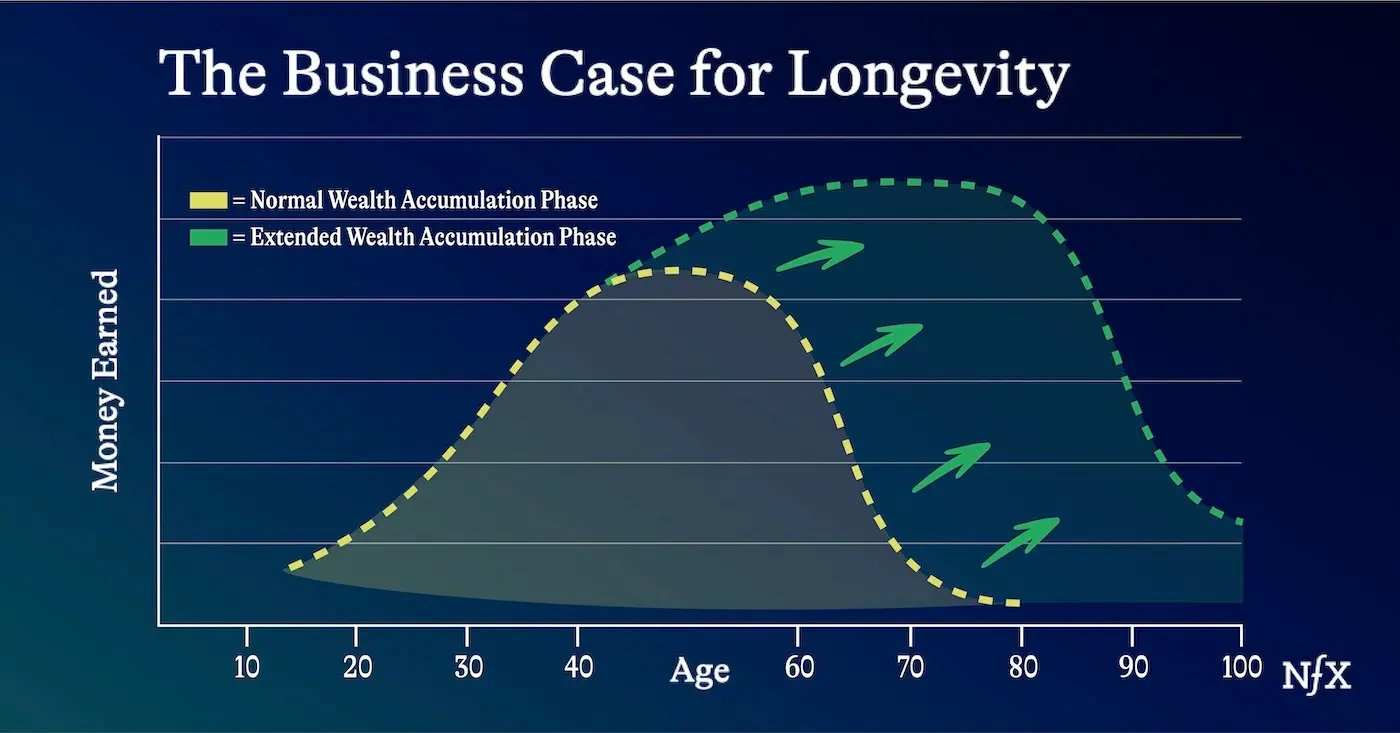
by Omri Drory, Ph.D.

Longevity is the biggest market in the world.

The ROI is huge, almost too big to see. Many people also don’t realize that longevity businesses are critical for the future of humanity.

Imagine not being resigned to growing old, frail and sick. Imagine being able to extend your peak earning years. Imagine being able to delay having kids safely (if you choose!) to allow yourself more time to pursue a career. People could have second or third careers. People could invest their money over longer periods of time, accumulating more wealth. People could have the opportunity to actually enjoy that wealth before they die.

If we can extend the human healthspan, it will not just save tons of money (think of all the money dedicated to playing whack-a-mole with age-related diseases). It will also make almost every other industry bigger.

Full article:

Of course, one counter-argument to this business case is that increased longevity will primarily benefit the wealthy and will lead to even greater inequality than the already extreme levels: The Cure for Death Means Billionaires Will Live Forever—and Be Rich Forever

RapAdmin

Rapamycin, an approved drug for transplant and cardiac patients, is extending the lifespan of mice by up to 20% [actually about 30%]. Scientists are exploring if it could have a similar effect on humans

Michel Samson turns 80 this month, and his goal is to change the trajectory of his life.

At 90 or even 100 years old, he’d like to be able to do household chores, have good grip strength, get up off the floor without help, and put his luggage in the overhead compartment of a plane.

“I’m interested in changing the curve of my life. For most people, as they get older, their health starts to fail. Their quality of life isn’t ideal. I believe it’s possible to change the trajectory of the last decades of one’s life.”

Based in Kentucky, Samson, a violinist who taught at the University of Louisville, tells the Irish Examiner that he’s interested in increasing his health span: the number of years he stays healthy.

He has been taking Rapamycin for the past five years, a drug popular in the US for promoting longevity and anti-ageing.

Kaeberlein estimates that the number of off-label users of Rapamycin for health-span reasons in the US is more than 10,000. “I doubt it’s over 50,000 yet, but now there are a couple of telehealth Rapamycin providers, it’s possible,” he says.

Elizabeth_Kirby

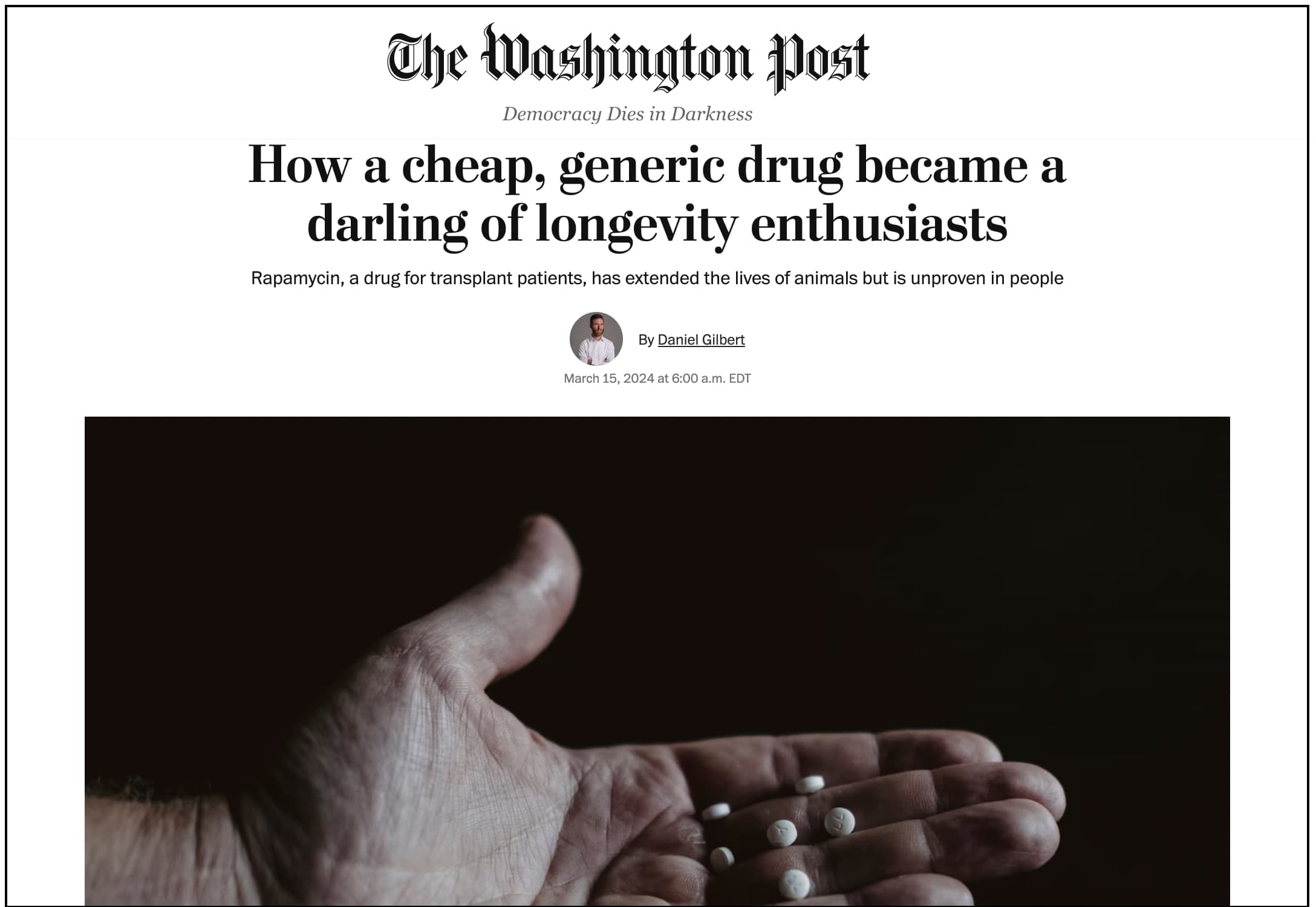
Today’s Washington Post has a new article on rapamycin. Many of us think rapamycin is compelling because it is FDA approved, has been in use for over 20 years, and lengthens healthy lifespan in every organism its been tested, including mice (typically 15% to 30% lifespan improvement, but up to 34% when combined with acarbose). Daniel Gilbert, of the Washington Post, reports:

Despite the buzz surrounding the drug, it is unlikely that the Food and Drug Administration will ever approve it for longevity. The agency doesn’t consider aging to be a disease, and rapamycin’s generic status means there’s little financial incentive to run expensive clinical trials to test it on age-related afflictions.

The enthusiasm for the drug’s anti-aging properties comes from studies that repeatedly have shown benefits in animals across multiple species, including yeast, worms and mice. Some physicians and researchers believe that if taken intermittently and in low doses, rapamycin can increase human life span the way it has in animal trials. But doctors also caution that no one knows what the optimal dose might be for humans, and taking certain quantities [i.e. extremely high doses] of rapamycin can lead to reproductive harm and insulin resistance as well as making the body more susceptible to infection.

Brad Rosen, a doctor in Los Angeles, says he believes rapamycin’s potential is compelling enough for him to try.

“At 60, I don’t have the luxury of expecting studies to be completed that can validate the benefits of a longevity drug prior to my own steeper decline,” said Rosen, who also has prescribed the drug to about 250 patients. The promising animal studies, combined with rapamycin’s long history as an immune-suppressing drug, he said, makes it “one of few agents where taking a calculated risk can absolutely make sense.”

Read the full Article: How a cheap, generic drug became a darling of longevity enthusiasts (Washington Post)

Related: Eric Verdin (CEO of the Buck Institute) Takes Rapamycin
Related: 80% of Longevity Experts Predict Significant Benefits for Rapamycin in Humans
Related: Yes, the Dose Really Does Make the Poison (Skeptoid Blog)

RapAdmin

这个消息对于我们的典型论坛成员来说特别有趣,因为这是两种仿制药的组合,现在很容易买到,而且价格便宜。因此,人们可以自己尝试并报告结果。请参阅本文讨论主题中的详细信息。

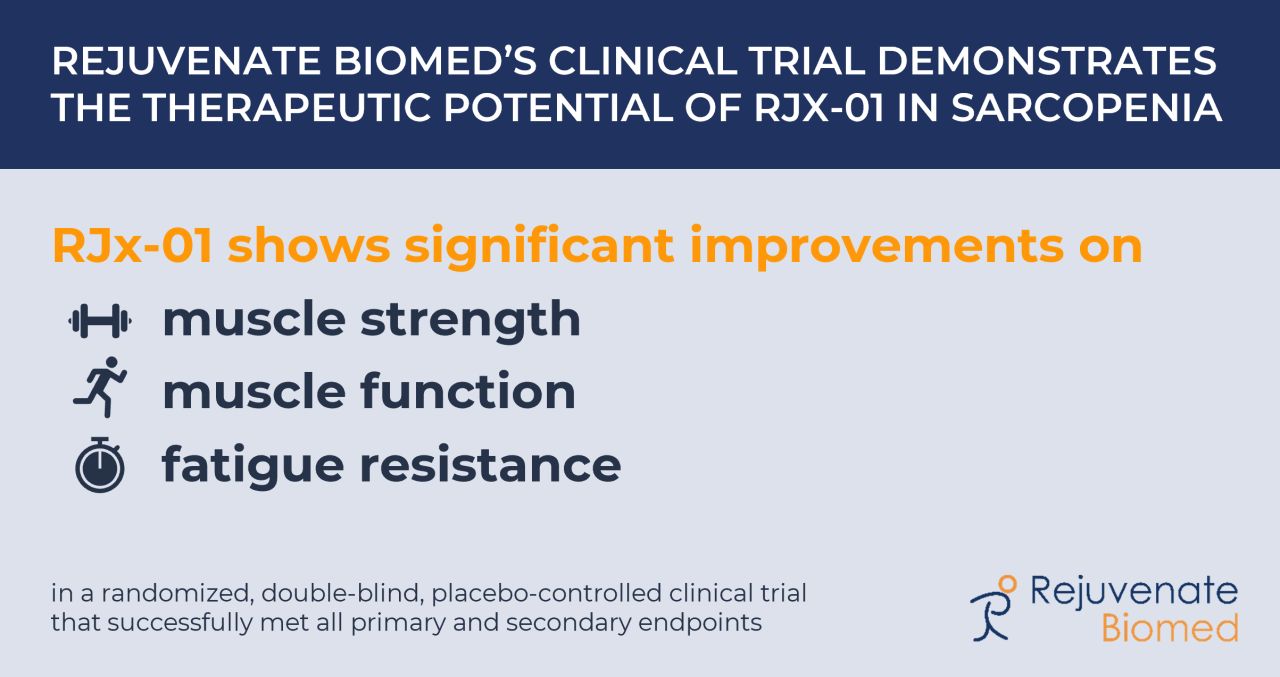
Rejuvenate Biomed 的临床试验证明了 RJx-01 在肌肉减少症方面的治疗潜力

尖端疗法显示出对肌肉力量、功能和抗疲劳能力的有意义的改善,为数百万人患有肌肉减少症的人带来了希望

比利时迪彭贝克,2024 年 2 月 21 日– Rejuvenate Biomed NV(“Rejuvenate Biomed”)是一家致力于通过创新疗法增强终身健康的开创性临床阶段平台和管道公司,今天宣布其 1b 期铅试验的突破性功能结果结果用于治疗肌肉减少症的候选 RJx-01。

肌少症是一种影响高达 22% 的 65 岁老人和 50% 的 80 岁老人的疾病,其特点是肌肉力量和身体机能逐渐丧失。这种下降不仅影响生活质量,还增加跌倒、残疾和死亡的风险,尤其是老年人口。

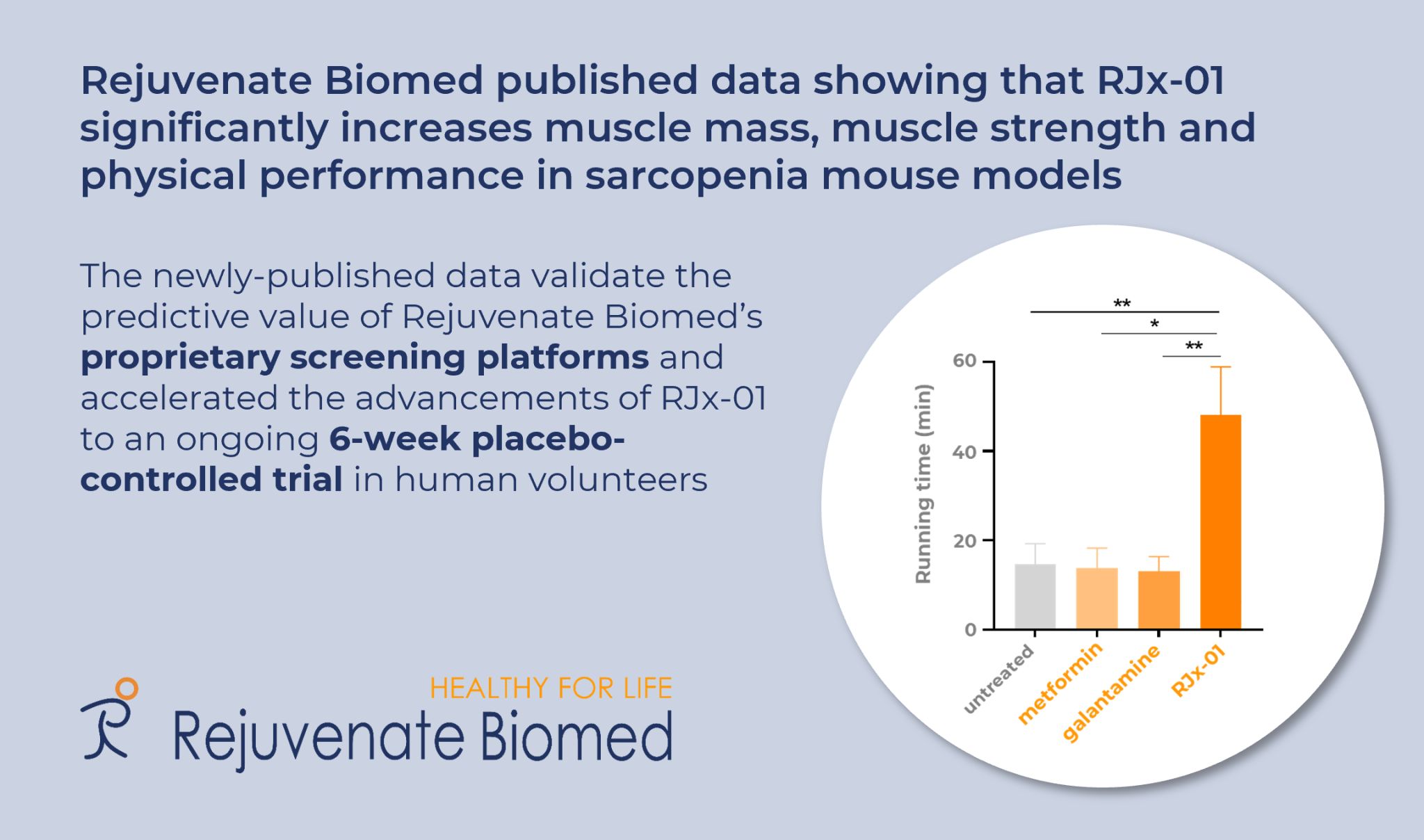
RJx-01是一种专有的组合药物[由二甲双胍和加兰他敏组成],经公司内部药物发现平台鉴定,并已证明对各种肌少症临床前模型具有有益作用[1]。最近的探索性临床试验结果是在早期确认安全性、耐受性和药代动力学之后得出的[2],突显了 RJx-01 在解决有效肌肉减少症治疗未得到满足的需求方面的潜力。

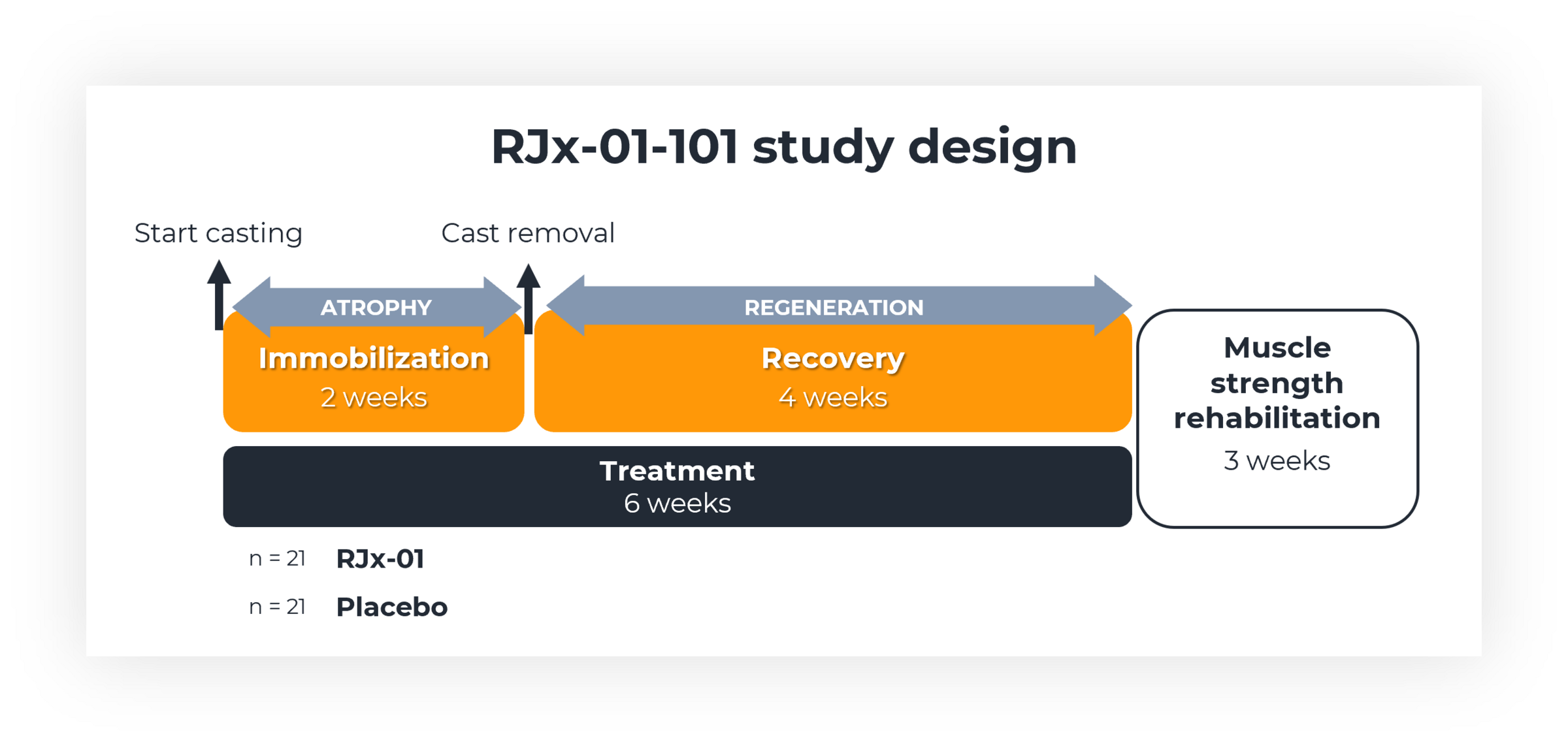
对 42 名年龄在 65 岁至 75 岁之间的健康志愿者进行的首次测试产生了“奇妙”的结果。参与者的一条腿接受了为期两周的石膏固定。由于固定,他们失去了肌肉力量。然后每个人都接受了培训计划。在接受球体形式药物的参与者中,股四头肌和腿筋的恢复速度明显更快。其他参与者接受了安慰剂。在肌肉疲劳(长时间努力后)和肌肉反应性(作为稳定性指标)方面,统计上的得分也显着提高。

这是 Rejuvenate Biomed 的首场胜利。 ”对患者的研究仍在继续。这是理所当然的。如果我们的治疗能够稳定病情,那就相当多了。这样可以进行早期干预。但我们当然希望有所改进”, Rejuvenate 首席执行官兼创始人 Ann Beliën说道。

肌肉减少症对老年人的生活质量产生不利影响。 ’我和父亲一起看到了。首先是拄着拐杖行走,然后是助行器,最后是轮椅。肌肉减少意味着不再能够打开瓶盖、步行距离减少、难以购买杂货、探望孙子。就是关于那些事情。我们不是要让老年人跑马拉松,而是让他们回归正常的社会生活,让他们随着年龄的增长而活动。 '

RJx-01 1b 期试验的主要结果揭示了有希望的功能结果:

  1. 改善力量:与安慰剂组相比,接受 RJx-01 治疗的废用性肌少症参与者在肌肉力量恢复方面表现出有希望的改善。通过等长测力法评估的这种有益效果强调了 RJx-01 促进肌肉力量改善的能力,这一结果将支持肌肉减少症患者的日常活动。
  2. 改善肌肉功能:通过等速测力法评估,RJx-01 治疗显着改善了腿部加速度。肢体快速加速的能力对于日常活动中的功能性运动非常重要,并且对于减轻跌倒风险至关重要——这是肌少症患者的一个重要考虑因素。
  3. 提高抗疲劳能力:通过监测一系列腿部锻炼期间的肌肉参数来评估神经肌肉疲劳。接受 RJx-01 的参与者表现出疲劳倾向降低,这表明 RJx-01 可以促进步行等体力活动,这对肌少症患者来说很重要的表现改善。

Rejuvenate Biomed 创始人兼首席执行官 Ann Beliën 博士表达了她的热情,她表示: “今天是我们解决与年龄相关疾病的关键时刻,尤其是肌肉减少症——这种疾病影响着多达五分之一的老年患者。 65 年。 RJx-01 所表现出的影响具有巨大的潜力,可以为因其他潜在因素而导致肌少症或肌肉力量丧失的个体带来重大改变。我们热切期待在今年晚些时候推进我们的 2 期项目,旨在证实 RJx-01 在解决肌肉减少症和骨质疏松症方面的治疗潜力。”

Rejuvenate Biomed 临床顾问委员会主席 Jean-Yves Reginster 教授博士补充道: “这些令人信服的数据证实了 RJx-01 改善身体表现和肌肉力量的承诺。随着人口老龄化,患有长期健康问题的人数不可避免地会增加,从而对人的功能能力和整体身体表现提出挑战。因此,像 Rejuvenate Biomed 这样的公司致力于治疗甚至预防肌肉减少症等与年龄相关的疾病的发展这一目标至关重要。”

Rejuvenate Biomed 临床顾问委员会成员 Roger Fielding 教授博士回应了他的强烈支持: “患有肌肉相关疾病的人数正在增加,强调迫切需要可行的解决方案来改善与年龄相关的肌肉衰退表现。 Rejuvenate Biomed 今天公布的有关 RJx-01 的新数据对于肌少症患者以及因其他原因导致肌肉功能丧失的患者来说非常有希望。”

Rejuvenate Biomed 将开始一项 2 期研究,评估 RJx-01 对肌肉减少症和骨质疏松症的影响,因为这两种疾病经常共存,以至于“骨肌肉减少症”最近在医学文献中被描述为一种独特的综合征。此外,该公司正在积极探索合作机会,以研究 RJx-01 与 GLP-1 药物的组合,这些药物已上市用于治疗肥胖和 2 型糖尿病。

1b 期试验的积极结果验证了 Rejuvenate Biomed 专有药物发现平台 CombinAgeTM 和 CelegAgeTM 的预测能力,该平台可有效筛选小分子,以确定针对年龄相关途径的有前景的治疗方法。 Rejuvenate Biomed 打算通过战略合作伙伴关系或许可协议向第三方提供这些平台。

  1. Tezze C, et al. JCI Insight 2023; 8(15):e168787. JCI Insight - A combination of metformin and galantamine exhibits synergistic benefits in the treatment of sarcopenia
  2. Rejuvenate Biomed - 肌少症 1b 期试验取得积极结果

相关

(加兰他敏 + 二甲双胍)概述

联合药物二甲双胍和加兰他敏 (RJx-01) 正在开发中,用于治疗肌肉减少症、废用性肌肉萎缩和未明确的适应症。该候选药物是一种小分子组合产品。它通过口服途径给药。它是基于人工智能驱动的技术平台开发的。

资料来源:https: //www.pharmaceutical-technology.com/data-insights/galantamine-metformin-rejuvenate-biomed-sarcopenia-likelihood-of-approval/

二甲双胍和加兰他敏的组合在治疗肌肉减少症方面表现出协同效益

https://pubmed.ncbi.nlm.nih.gov/37551712/

继续本文的讨论主题

RapAdmin

20 年前,科学家们发现了如何通过改变一个单一基因使老鼠的寿命延长 1.5 倍。自这一突破性发现以来,我们学到了什么?

在他们的首个视频中, age1探索了减缓小鼠衰老的干预措施,重点介绍了干预测试项目的工作,并以理查德·米勒博士本人为主角。

我鼓励大家点击“订阅”这个频道,因为我确信这只是许多精彩视频中的第一个。

这只微小的突变小鼠如何活得这么久(Age1)

视频链接: https://www.youtube.com/watch?v =RIoB6HWfMFc