Well, here’s a paradox for you. I had lower BP on 20mg/day telmi than I have now on 40mg/day. Not huge, but definitely significant, about SBP 8 points and DBP 4 points - these are not fluke readings, I always take them at the same time with the same device, consistently. So who knows, maybe something else has changed, though I can’t think what that would be diet, exercise supplements all kept steady  .
.
1 Like
RapAdmin
#668
Another option…
Here’s the breakdown for telmisartan (Micardis and generics) and pill splitting:
1. Tablet formulation
- Telmisartan is supplied as film-coated tablets in fixed strengths (20 mg, 40 mg, 80 mg).
- The coating is not an extended-release or enteric-release technology; it is mainly to improve stability (telmisartan is moisture-sensitive).
- That means splitting does not destroy a time-release system — you still get the same pharmacokinetics.
2. Practicality of splitting
- The tablets are not scored, so breaking them may not give perfectly even halves.
- If you split them, you may see some crumbling, but the drug content should remain stable if consumed soon after.
- Because telmisartan is moisture-sensitive, storing split halves for long periods (weeks/months) is not ideal — the coating helps protect the active drug from degradation.
3. Dosing flexibility
- Clinically, many physicians do split telmisartan tablets (especially the 80 mg ones) to achieve intermediate doses like 40 mg or 20 mg at lower cost.
- Pharmacists often note that variability in split dose (±10–15%) is usually acceptable for blood pressure medications like ARBs, since dosing is titrated to effect and safety margins are wide.
4. Cost considerations
- In some markets, higher-strength tablets (e.g., 80 mg) cost the same as lower-strength ones. Splitting can therefore save money when prescribed by a doctor.
- Insurance and pharmacy policies may differ — sometimes the pharmacy benefit manager disallows splitting.
 Bottom line:
Yes, telmisartan can generally be split without losing effectiveness, since it is not extended-release. The main issues are dose unevenness and stability after splitting. If you do it:
- Use a proper pill splitter, not a knife.
- Split only what you’ll use in the next few days to weeks (don’t store for months).
- Keep the halves in a dry, airtight container to limit moisture exposure.
 Always confirm with your prescribing doctor or pharmacist, because local formulations and coatings can vary slightly.
1 Like
Note, this may not be applicable to the telmisartan you buy from India. I bought 40mg pills Teleact Ranbaxy/Sun Pharma and they are indeed scored in the middle. Nonetheless it is very true they are moisture sensitive. Also, even though they are scored in the middle, splitting them is tricky, because they tend to crumble very easily, so you are left with two uneven “halves”, and some crumbs and powder. You have to use good splitting technique.
Thanks @RapAdmin I currently use the 40 mg tabs and split them to 20 mg. I like to save money on my daily meds. 
Nice effect on adiponectin. The increase in adiponectin might be caused by telmisartan being a PPARgamma agonist but activation of PPARgamma can increase subcutaneous fat but reduce visceral fat and the reduction in visceral fat increases adiponectin.
Jonas
#673
Interesting comments on Taurine and BP:
Taurine is the most underrated supplement when it comes to blood pressure, abundantly found in heart muscle tissue, modulates calcium handling, reduces sympathetic tone, and enhances nitric oxide.
https://x.com/biohacker/status/1978081005589155926
6 Likes
Is the cuff charged or have fresh batteries?
It’s fully charged. I just used it tonight. The measurements were 123/69. It only goes into the high 90s when I take Telmisartan 20 mg. 123 is a little high, but it’s better than too low and passing out. I guess I’ll have to wait for my arteries to clog up more before taking Telmisartan. 
Success! By switching to tadalifil from Telmisartan, I am able to get my SBP into the 100-110 range. This is optimal for me because if my SBP dips below 100, I start to feel dizzy, nauseous, fatigued and uncomfortable. 100-110 is my sweet spot where I feel normal and yet my SBP is low enough to feel that I am healthy.
Telmisartan took my SBP and DBP too low 90-100 for SBP and below 55 for DBP which is probably not healthy for me. It’s a great drug for anyone who needs more aggressive BP lowering though.
5 Likes
scta123
#677
What is your dose? I am taking 2.5 mg and my BP decreased just few points, nothing worth mentioning really.
I just take the normal dose of one 5 mg pill in the morning. When I measure my SBP it’s in my target range.
1 Like
jjrap1
#679
Just curious: since the half-life of tadalafil is < 24 hrs, have you taken your BP right before your next dose to check if it drifted upward?
1 Like
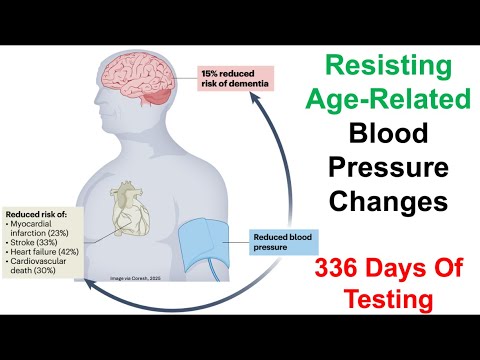
Resisting Age-Related Blood Pressure Changes: 336 Days Of Testing
Conquer Aging Or Die Trying! Mike Lustgarten, PhD
AI Summary:
Focus on Longevity and Biomarkers
- The channel aims to optimize biomarkers across various organ systems, such as the kidney, liver, immune system, and metabolic health.
- A significant aspect of this focus is the regular tracking of blood pressure, which raises the question of its importance in health outcomes.
- Research indicates that reducing blood pressure can lead to a 15% lower risk of dementia and decreased cardiovascular-related events, including heart attacks and strokes.
Understanding Blood Pressure Changes with Age
- Systolic blood pressure tends to increase with aging, while diastolic blood pressure increases until midlife and then declines.
- The data presented spans from September 2022 to early May 2025, encompassing 336 measurements of systolic and diastolic blood pressure.
Data Collection Methodology
- Blood pressure measurements were standardized to a specific time frame, taken between 11:30 AM and 1:00 PM, to minimize variability.
- The speaker took blood pressure readings five to six times within that time window, averaging the results for accuracy.
- Measurements were conducted four to five hours after consuming food or water, ensuring consistency in testing conditions.
Systolic and Diastolic Blood Pressure Trends
- The average systolic blood pressure recorded was 122 mmHg in 2022, decreasing to 119 mmHg in 2023, 118 mmHg in 2024, and remaining at around 118 mmHg in early 2025.
- For diastolic blood pressure, averages were approximately 73 mmHg in 2022, 69 mmHg in 2023, and returning to about 70 mmHg in early 2025.
- The speaker highlights their ability to maintain blood pressure levels lower than the expected values for their chronological age of 52 years.
Factors Influencing Blood Pressure
- The speaker suggests that a lower body weight may be a contributing factor to their ability to resist age-related increases in blood pressure.
- A correlation analysis shows a significant positive relationship between body weight and both systolic and diastolic blood pressure.
- When the speaker’s body weight was around 138 to 140 pounds, their blood pressure readings were at their most youthful levels.
Future Plans and Diet Tracking
- The speaker plans to monitor dietary correlations with blood pressure and make adjustments if necessary to maintain youthful blood pressure levels.
- They emphasize the importance of tracking food intake, macro and micronutrient consumption, and their impact on blood pressure.
2 Likes
RapAdmin
#681
I was reviewing the transcript of this recent Optispan / Kaeberlein interview with Brad Stanfield and saw this statement:
In a moment of personal revelation, Dr. Stanfield shared that he personally uses an SGLT2 inhibitor. He takes it not for diabetes, but as an “off-guideline” treatment for his high blood pressure, a decision made as an informed patient in consultation with his kidney doctor.
and I was a little surprised as I had not noticed this before. So - I looked into it more. Here is the summary of the research and clinical evidence on SGLT2 inhibitors lowering blood pressure:
CGPT5 Response:
Short version: yes—SGLT2 inhibitors lower blood pressure, but the effect is modest (roughly −3 to −5 mmHg systolic and −1 to −2 mmHg diastolic on average), seen on both clinic and 24-hour ambulatory monitoring, across diabetes, CKD, and heart-failure populations.
What the best evidence shows
-
Meta-analyses (ABPM + office BP): Class effect of ~−3.5/−1.7 mmHg on 24-h BP; consistent office SBP reductions as well.
-
Ambulatory BP RCTs: Empagliflozin lowered 24-h SBP/DBP in randomized trials and ABPM cohorts (daytime and especially nighttime dips). Typical magnitude ≈ −5/−2 mmHg at 1 month.
-
Resistant hypertension: In patients with apparent treatment-resistant HTN on background meds, dapagliflozinproduced additional BP lowering vs placebo (modest but significant).
-
CKD: DAPA-CKD analyses show modest SBP/DBP reductions with dapagliflozin; effects seen with and without diabetes.
-
Heart failure (HFrEF/HFpEF): Trials (DAPA-HF, EMPEROR) report small average SBP decreases (~1–3 mmHg) while outcome benefits occur across baseline BP strata.
-
Who drops the most: Higher starting BP and nighttime BP tend to show larger falls; ABPM often shows a slightly bigger effect than office readings.
How they lower BP (mechanisms with human data)
-
Mild natriuretic/osmotic diuresis → plasma-volume contraction (early hemoconcentration signal; measured reductions in estimated plasma volume).
-
Reduced arterial stiffness / improved vascular compliance (pulse-wave-velocity and related measures improve).
-
Weight loss contributes (analyses attribute a meaningful fraction—on the order of ~40%—of BP fall to weight change).
-
Possible sympathetic dampening (trial comparing empagliflozin with HCT looked at muscle sympathetic nerve activity).
Practical takeaways
-
Magnitude: Expect ~3–5 mmHg SBP lowering on average; larger in those with higher baseline BP and at night on ABPM.
-
Populations: Effects occur in T2D, CKD (with/without diabetes), HFrEF/HFpEF, and resistant HTN—though the BP effect is smaller than classic antihypertensives.
-
Safety/monitoring: Watch for volume depletion/orthostasis, especially in elderly or with loop diuretics; adjust other diuretics if symptomatic. (Monitored in the cited RCTs/meta-analyses.)
3 Likes
He (Dr. Brad Stanfield) actually made a whole video about this, which I posted here - and it’s a pretty involved thing with polypharmacy, where he had to counteract some effects with other drugs:
7 Likes
Thanks! Even i miss many posts and threads.
4 Likes
adssx
#684
2 Likes
Bicep
#686
@RapAdmin a while back you posted about a new blood pressure product that also did something like pulse wave velocity? A bit more than that even. I can’t find it under blood pressure, or anything else actually. What was that thing? I need a new BP cuff anyway.