adssx
#1925
Serum Magnesium and the Effect of Empagliflozin in Heart Failure With Reduced Ejection Fraction: Findings From EMPEROR-Reduced 2025
Empagliflozin rapidly increased magnesium levels by 0.05 mmol/L. The relative odds of experiencing lower magnesium levels were reduced with empagliflozin.
4 Likes
LukeMV
#1926
Interesting because this replicates the findings of an earlier study. It’s basically a magnesium supplement too.
2 Likes
Boy, that’s a very looooong limb to go out on. I’m not saying it can’t be relevant - as the authors speculate - to “obese prepubescent children with early renal disease”, but as they also note in those particular rats (SSLepRmutant) SGLT2 expression is very elevated to begin with. I suspect many things can interfere with such already very elevated SGLT2 expression, and I’m not sure how that would look in normal level SGLT2 expression, would rapamycin still inhibit SGLT2? Also, as noted this is effect of rapamycin is downstream from the insulin-hyperglycemia axis, so how relevant it’s going to be in normoglycemic normal level insulin, I don’t know.
It’s interesting, but not something I’m going to get super excited over, as my ambition is to lower insulin levels and also glucose levels. Rapamycin here might be orthogonal to those who already use an SGLT2i, such as empagliflozin (as I do). YMMV.
2 Likes
SGLT2 Inhibitors and Kidney Outcomes by Glomerular Filtration Rate and Albuminuria
https://jamanetwork.com/journals/jama/fullarticle/2841163
"Key Points
Question Do the kidney protective effects of sodium-glucose cotransporter 2 (SGLT2) inhibitors vary by estimated glomerular filtration rate (eGFR) or albuminuria?
Findings In this meta-analysis that included 70 361 participants in 10 trials of SGLT2 inhibitors vs placebo, SGLT2 inhibitors significantly reduced progression of chronic kidney disease (CKD), serious acute kidney injury, and kidney failure. The relative risk reduction for CKD progression was consistent regardless of eGFR and albuminuria. Significant reductions in the annual rate of eGFR decline were observed across all subgroups, including when participants with and without diabetes were analyzed separately.
Meaning These findings support the routine use of SGLT2 inhibitors to improve kidney outcomes across the full spectrum of kidney function and albuminuria among patients with type 2 diabetes, CKD, or heart failure."
7 Likes
tj_long
#1929
What do you think about this study? My own experience is that dapagliflozin caused me anxiety. I might try again at some point, perhaps with empagliflozin.
https://www.sciencedirect.com/science/article/pii/S2213398424000514
T2DM patients taking SGLT2 inhibitors exhibited significantly higher levels of thyroid-stimulating hormone (TSH) compared to controls (p < 0.001). Additionally, T2DM patients on SGLT2 inhibitors showed a higher prevalence of mild to moderate depression (p < 0.001, odds ratio = 1.74) and cognitive impairment (p = 0.039, odds ratio = 1.32) compared to controls. Subgroup analysis revealed varying effects among different SGLT2 inhibitors on depression and cognitive function
1 Like
To be clear, the subjects taking an SGLT2i had a history of diabetes while the controls were healthy subjects without a history of diabetes. This is not a study of two randomized groups of healthy subjects where one group took an SGLT2i and one did not. It was also not a study of two randomized subjects with T2DM where one group took an SGLT2i and one did not.
5 Likes
adssx
#1931
Indian paper = trash most of the time. IIRC, other studies looking at SGLT2 and depression found benefits or neutral.
2 Likes
Satchel
#1932
I am currently taking 10mg empagliflozin and have zero side effects. I am not type2d. tried taking 20mg-same same- no side effects. no improvement either in insulin/glucose. My question is more always better? or can i stay at 10 mg?
1 Like
Davin8r
#1933
More is not necessarily better, but nobody can answer your question definitively because there aren’t any health outcome studies with SGLT2i drugs in healthy subjects. 25mg is slightly better than 10mg at increasing glucose excretion in the urine, but most in the life extension community are taking it for its potential pleiotropic benefits.
2 Likes
FWIW, empagliflozin at 12.5mg/day did absolutely nothing for my glucose levels in the 5 months I’ve taken it. I bumped it up to 25mg/day, and re-tested several times in the 6 months at that dose, and while it did nothing for my A1c (5.7-5.8), it reliably brought my FBS to under 100mg/dL (95-98), while previously it had been at 105-112 mg/dL (dawn effect).
Based on that I’m sticking to the 25mg/day dose. I see no downsides to that dose and rather like the possible greater glucose excretion at the higher dose. There are no advantages to the lower dose that I know of - initially I was at a lower dose because I didn’t know how my body would react to empagliflozin, so I wanted to start at a lower dose in case of an unexpected negative reaction (i.e. a safety precaution).
But of course you should test and monitor the effects in yourself, as all of us are unique.
1 Like
The biggest upside to 12.5 mg vs 25 mg is that your supply lasts twice as long. I split the 25s. Based on what I’ve seen, the results are similar between the doses and you get most of the bang for the buck in the initial dose compared to doubling it.
3 Likes
adssx
#1936
Just published, low dose might be as good if not better: Real-world outcomes and safety of low- vs. standard-dose SGLT2 inhibitors in heart failure 2025
After matching, 46,218 patients remained (23,209 in each group) and baseline characteristics were well-balanced (absolute standardized differences < 0.1). The primary outcome incidence was 6.0 per 100 person-years in both groups. After multivariable adjustment, Low-dose SGLT2i was associated with a lower risk of the composite outcome (HR 0.93, 95% CI 0.88–0.99, p=0.02) and CV hospitalization (HR 0.84, 95% CI 0.78–0.91, p<0.0001), with no significant differences in HF hospitalization (HR 0.93, p=0.33) or mortality (HR 1.04, p=0.47). The incidence of genital mycotic infections and other adverse events was similar in both groups.
4 Likes
adssx
#1937
Ah another new article that says the opposite lol: Off-label low-dose therapy in heart failure reduced ejection fraction: can we achieve the benefits of the four pillars?
However, SGLT2 inhibitors showed a trend to improve outcome in target dose. However, follow-up echocardiography (n=415) showed that an improvement in LVEF of ≥10% was more frequently observed in patients who had achieved the target dose of each medication. (Target dose RASi= 79.4%, BB= 72.5%, MRA=61.8%, and SGLT2i=64.8%
3 Likes
adssx
#1938
Other good articles:
Abstract 4358270: Sodium-Glucose Cotransporter-2 Inhibitor Use Is Associated with Improved Cognitive Outcomes in Older Heart Failure Patients: A Comparative Analysis Using Real-World Clinical Data 2025
In a real-world study of older adults with heart failure, empagliflozin and dapagliflozin use was associated with a lower risk of incident cognitive impairment.
Abstract 4367702: Evaluating The Causal Role Of SGLT2 Inhibition In Cerebrovascular Disease: A Systematic Review And Meta-Analysis Of Mendelian Randomization Studies 2025
Our study provides strong evidence supporting causal, protective effect of SGLT2 inhibition against stroke, particularly ischemic stroke, based on MR. The consistent findings across diverse GWAS exposures and robust sensitivity analyses underscore therapeutic potential of SGLT2 inhibition in stroke prevention. However, high heterogeneity in the overall model and broader stroke subgroup warrants further studies.
Dapagliflozin and blood pressure control in type 2 diabetes: a meta-analysis of randomised clinical trials 2025
The pooled analysis showed that dapagliflozin significantly reduced office SBP (MD -3.08 mmHg, 95% CI -3.45 to -2.71; p < 0.00001; I² = 0%; Figure 1A) and office DBP (MD -1.10 mmHg, 95% CI -1.86 to -0.34; p = 0.004; I² = 0%; Figure 1B). Similar reductions were observed in 24-hour SBP (MD -3.53 mmHg, 95% CI -5.03 to -2.03; p < 0.00001; I² = 0%; Figure 2A) and 24-hour DBP (MD -2.13 mmHg, 95% CI -3.58 to -0.67; p = 0.004; I² = 11%; Figure 2B).
Comparative effectiveness of GLP-1 receptor agonists, DPP-4 inhibitors, and SGLT-2 inhibitors on cardiovascular outcomes: A comprehensive Bayesian network meta-analysis with intervention ranking 2025
Dapagliflozin suppresses vascular smooth muscle cell senescence by promoting autophagy 2025
This study reveals that Dapa could suppresses vascular aging via promoting autophagy.
Outcomes of empagliflozin versus dapagliflozin treatment in patients with heart failure based on left ventricular ejection fraction: a multicentre cohort study 2025
Empagliflozin and dapagliflozin showed no significant difference in the primary outcome (13.8% vs. 14.8% in LVEF≤ 40%, 5.5% vs. 5.3% in 40<LVEF<50%, 4.8% vs. 6.0% in 50%≤LVEF), without heterogeneity (P for interaction=0.777).
This study suggests that dapagliflozin and empagliflozin have similar clinical outcomes in the management of HF across all ranges of LVEF in a real-world setting.
Empagliflozin versus metformin for glucose variability and metabolic outcomes in drug-naïve type 2 diabetes: The EMPA-FIT study 2025
46 drug-naïve adults with T2D (HbA1c 6.5 %–10.0 %) received empagliflozin (10 mg/day; n = 23) or metformin (1000 mg/day; n = 23) for 12 weeks
Empagliflozin significantly reduced mean amplitude of glucose excursions (MAGE) compared to metformin in drug-naïve individuals with type 2 diabetes.
Time-in-range (TIR) improved significantly in both groups, but only empagliflozin demonstrated superior reduction in glucose variability.
Empagliflozin led to greater improvements in body weight, waist circumference, triglycerides, and HDL-cholesterol levels than metformin.
9 Likes
tj_long
#1939
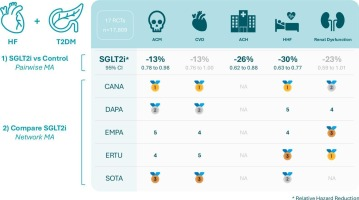
Has this been discussed here? For all-cause mortality (ACM), canagliflozin is ranked first and dapagliflozin second. I don’t have access to read the full study.
3 Likes
adssx
#1940
Impact of sodium glucose cotransporter 2 inhibitors on bladder cancer and breast cancer: a pharmacovigilance analysis and mendelian randomization study 2025
SGLT2 inhibitors were associated with a disproportionately higher reporting frequency of bladder cancer events compared to metformin, dipeptidyl peptidase 4 inhibitors, or glucagon-like peptide-1 receptor agonists. MR analysis results showed that SGLT2 inhibition was associated with a higher risk of bladder cancer (odds ratio 1.01; 95%CI 1.00-1.01; p = 0.004).
Bad news? But the OR seems very tiny (1.01): is that clinically significant? What do you think @Neo?
5 Likes
It kind of makes sense in that you are dumping sugars (cancer and bacteria food) directly into your bladder.
3 Likes
Fasting hijacks proximal tubule circadian control mechanisms to regulate glucose reabsorption via the Nrf1/Sglt2 pathway in mice
Herein, we identified previously unknown fasting-induced, glucagon-mediated inhibitory effect of the circadian clock gene basic helix-loop-helix ARNT like 1 (Bmal1) on the expression of the main proximal tubule glucose transporter solute carrier family 5 member 2 (Sglt2) in mice. During fasting, glucagon induces Bmal1, which increases expression of nuclear receptor subfamily 1, group D, member 1 (Rev-erbα). Rev-erbα represses nuclear respiratory factor 1, a transcriptional activator of Sglt2, and diminishes Sglt2 expression and thereby kidney glucose reabsorption capacity. During refeeding (lower glucagon) this process is attenuated, thereby inducing glucose reabsorption.
Summary : During fasting, glucagon release inhibits glucose reabsorption by inhibiting SGLT2. So it seems that dual GLP1 and Glucagon agonists (survodutide, mazdutide, retatrutide ) are also milder SGLT2 inhibitors. It will be interesting if studies ever compare those dual glucagon agonists to SGLT2 inhibitors.
I did not realize this, but glucagon becomes elevated during fasting. Glucagon releases glucose, and does not allow glucose reabsorption in the muscles because we need that glucose for energy while fasting.
1 Like
Coincidentally, I was just investigating this confluence of biomechanisms, because I had to take a bunch of blood tests in preparation for my upcoming surgery. There were a few abnormalites flagged as values ouside of the range of the UCLA lab. One was serum chloride at 107 mmol/L (range 96 - 106) with blood sodium within range 144 mmol/L (range 135 - 146), and serum potassium out of range at 5.4 mmol/L (range 3.6 - 5.3). Meanwhile on the urine test, there was glucose present in high amounts +4 (obviously - I take empagliflozin) with normal blood glucose (95 mg/dL), and trace ketones, both flagged as “abnormal”.
In any case, upon investigation, there are a number of possible causes of such values, including dehydration, fasting, intense exercise which depletes glucose stores in muscles, use of SGLT2i which dumps glucose in fasting conditions leading to elevations in glucagon and ketones. There’s a whole bunch of papers I could cite, but the bottom line is this: if you exercise intensely (I do), fast (in my case daily TRF with overnight fasting 20-22 hours), or are on a ketogenic diet, you need to be careful with SGLT2i use before surgery, particularly if you are a T2DM concurrently using glucose lowering agents, particularly insulin (I’m not, and I don’t). The danger is euglacemic diabetic ketoacidosis (eDKA) which can result in death. It is recommended that you stop the SGLT2i at least 3 days before surgery, but longer is better (SGLT2i associated metabolites can persist in the body for 10+ days). Based upon my test results and various papers, out of an abundance of caution, I intend to stop my empagliflozin 12 days before the surgery (somewhat drastic, but given the potentially drastic consequences - death - I’d rather be extra cautious).
In any case, there are very interesting interplays between all these factors, especially impacting kidney health, so anyone taking a SGLT2i should be aware of them, and educate themselves in this subject matter.
1 Like
Neo
#1944
Yes seems very tiny. Do you know what the MR’s odd-ratio is per?


