I started watching this video where Ben Greenfield’s results are examined, at least to understand the test.

My coach swears by the Prodrome products, claiming that that his clients experience a noticable difference in performance when resistance training from the Glia product. He recommends both and has a 25% discount code, so I may try them next month.

Two weeks on his program and my RHR is the lowest in 2 years and body fat is rapidly approaching 10% for the first time, so I’m gaining trust in his opinion even though he has a conflict of interest: he gets free plasmalogens as kickbacks.

I am trying to identify cheaper biomarkers to test before I start the experiment. Probably markers of oxidative stress.

4 Likes

I read somewhere (and believe posted the source way back) that exogenous supplementation can down regulate internal production. I used to seem to feel a difference from taking them (not the Podrome as it’s too expensive but another brand) but lately I actually noticed that I didn’t feel jack anymore so I stopped my subscriptions. It could be the initial feeling was placebo or that eventually my endogenous production went down. But they’re off my stack too and I didn’t even see this Bryan Johnson bit till now.

1 Like

I wondered what the link between Plasmalogens and mitochondria may be so I asked chatGPT

It strikes me that there is probably a benefit from supplementation, but it would hit a limit. Whether supplementation reduces endogenous production such that the total is lower strikes me as unlikely.
From O3.

Bottom line

Plasmalogens are not passengers in the mitochondrial membrane—they are architects, body-guards, and traffic controllers all at once:

  1. Architects – sculpt cristae and tune membrane fluidity.
  2. Body-guards – quench ROS and protect the respiratory chain.
  3. Traffic controllers – license fission–fusion cycles and inter-organelle crosstalk.

Keeping their levels optimal is therefore a promising lever to preserve or restore mitochondrial health in a wide array of diseases.

3 Likes

O3 on the video

Quick take — what’s in the video?

Dr Dan Goodenowe, the founder of Prodrome Sciences (maker of the ProdromeScan blood test and the ProdromeNeuro™ plasmalogen supplement), walks through Ben Greenfield’s before-and-after blood panels.
Between the two draws Ben added:

  • Prodrome Neuro™ (plasmalogen precursor rich in DHA)
  • A mitochondrial stack (acetyl-L-carnitine, NAC, creatine)
  • Phospholipid “head-group” support (Alpha-GPC, Seriphos®).

Goodenowe claims the second test shows:

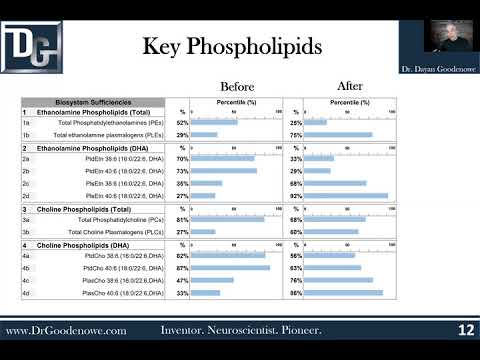
  • A ~2.6-fold rise in total plasmalogens (29 → 75 percentile) and a shift toward DHA-rich species.
  • Lower inflammatory markers (CRP 7.8 → 0.5 mg L-¹) and tighter “mitochondrial leakage” indices.
  • Improved peroxisomal fatty-acid oxidation and triglycerides (192 → 76 mg dL-¹).
  • Slight fall in homocysteine (6 → 9 µmol L-¹; still “good” by his threshold) and a bump in serum creatinine (0.9 → 1.3 mg dL-¹).

Goodenowe frames this as a real-world example of “immortality-science”—optimising biochemistry before overt disease.


1 ▸ Tidy transcript

Ben Greenfield Prodrome Scan – Structured Transcript

Speaker: Dr Dan Goodenow
Topic: Ben Greenfield’s blood-work before and after a supplementation round that included the plasmalogen-precursor Prodrome Neuro.


1 Session Overview

Item Detail
Goal Compare Ben’s initial Prodrome Scan (late 2020) with repeat testing “about a month ago” after targeted supplementation.
Key supplements added Prodrome Neuro (plasmalogen precursor), mitochondrial support, N-acetyl-l-cysteine, carnitine, Seriphos, α-GPC.

2 Conceptual Foundations

Concept Key points
Prodrome The biochemical “warning phase” that precedes overt disease.
Disease cascade Healthy → At-risk prodrome → Pathological disease → Death (if untreated).
Mortality science Treats disease symptoms to delay death.
Preventive medicine Treats prodromes to delay disease onset.
Immortality science Continuous functional maintenance; ignores “disease/time/death” models and focuses purely on biochemical function and optimization.

3 Purpose of Prodrome Scan

  1. Not a diagnostic for specific diseases.

  2. Inventoried key biochemical systems under two lenses:

    • Biosystem sufficiency: Are “fuel-tank” reserves adequate?
    • Reserve capacity: Do systems have head-room for stress (“rainy-day” function)?
  3. Each system can be optimized with environmental levers (diet, lifestyle, supplements).

  4. “The time to optimize your biochemistry is now.”


4 Ben’s Blood-Work Timeline

Time-point Context Notable remark
Baseline – late 2020 First Prodrome Scan Low plasmalogen percentile (exact values not shown).
Intervention Began targeted supplement stack (listed above).
Follow-up – ~1 month ago Second Prodrome Scan Used for comparison in this review.

5 Pre- vs Post-Supplement Snapshot (as reported)

Biomarker group Baseline percentile Follow-up percentile Direction
Plasmalogens Low Improved
Other key phospholipids (percentiles not specified) Changes discussed qualitatively Variable

(Exact numerical values were not provided in the transcript; only overall trends are mentioned.)


6 Key Take-Home Messages

  • Biochemical shifts precede clinical disease – catching and correcting them early is more powerful than symptom suppression.
  • Prodrome Scan is positioned as a functional-systems tool, guiding lifestyle and supplement prescriptions before disease appears.
  • Ben’s post-supplement results show plasmalogen repletion and broader lipid-profile improvements, illustrating how targeted nutrients can restore biochemical reserves.

7 Next Steps / Open Questions

  1. Lifestyle variables: Dr Goodenow notes he has not yet reviewed Ben’s concurrent diet, training, or sleep changes — these could amplify or confound blood-work shifts.
  2. Detailed data: Publishing the exact percentile tables or graphs would allow deeper interpretation.
  3. Ongoing monitoring: Iterative testing fits the “immortality science” approach — re-evaluate and fine-tune every few months.

This structured format distills the long-form transcript into logical sections for easier reference and future discussion. Let me know if you’d like further editing (e.g., slide deck format, deeper summaries, or visuals).


2 ▸ Executive summary (≈ 400 words)

Section Key points
ProdromeScan philosophy Looks for “prodromes” — early biochemical drifts that precede disease. Focus is on sufficiency (are lipid “fuel-tanks” full?) and reserve capacity (can systems handle extra load?).
Baseline panel (late 2020) • Low plasmalogens relative to phosphatidyl lipids.
• DHA : arachidonic ratio sub-optimal → suggests low omega-3 intake & greater inflammatory tone.
• CRP high (7.8 mg L-¹), triglycerides elevated (192 mg dL-¹).
Intervention period ~4 months of Prodrome Neuro (DHA plasmalogen precursor) plus mitochondrial and choline/ethanolamine support; no detailed diet or training log captured.
Follow-up panel (mid-2021) • Plasmalogens up to the 75th percentile; DHA species (2D, 4D) drive most of the gain.
• DHA rises, arachidonic drops in both PC and PE pools.
• CRP falls to 0.5; triglycerides to 76 mg dL-¹.
• Homocysteine inches up (6 → 9).
• Creatinine climbs (0.9 → 1.3); flagged to “keep an eye on”.
Interpretation offered 1) Supplement-provided DHA replenishes plasmalogens, reduces oxidative stress and inflammation. 2) NAC + carnitine “fix” leaky mitochondria. 3) High HDL + low LDL indicate efficient cholesterol recycling, not liver dysfunction.
Next steps Increase ethanolamine (Seriphos®) to keep PE pool up; monitor creatinine; book pre-order plug for Goodenowe’s book Breaking Alzheimer’s.

3 ▸ Critical appraisal

Strengths

  • Quantitative lipidomics — ProdromeScan measures hundreds of phospholipid species, giving a granular picture rarely offered in routine labs.
  • Clear n-of-1 narrative — the graphs are easy to follow, and Ben’s raw numbers are shown.

Limitations & concerns

Point Critique
Conflict of interest Dr Goodenowe both designed the test and sells the supplement whose success he is showcasing—a classic commercial bias scenario. (Prodrome)
N = 1 & no blinding Without a control arm (or even a repeated-measures washout), we cannot rule out diet, training load, lab variance, regression to the mean, or random day-to-day swings.
Biomarker validation Many indices (e.g., “mitochondrial leakage ratio”, “peroxisomal β-oxidation index”) are proprietary composites not independently validated. Standards such as CRP or triglycerides are well-established, but the novel ratios lack peer-reviewed reference ranges.
Evidence for plasmalogen therapy Pilot data in mild cognitive impairment showed increased blood plasmalogens and modest cognitive gains in 22 participants — but the study was open-label and short (4 months). (考研) Larger, placebo-controlled trials with clinical endpoints are still pending.
Immortality/“all-cause mortality” claims Goodenowe cites observational curves linking high plasmalogens to lower 5-year mortality. Association ≠ causation; reverse causality (healthier people have higher plasmalogens) is plausible. No RCT has shown that raising plasmalogens extends life or prevents dementia.
Homocysteine interpretation He treats 9 µmol L-¹ as “good”, yet large meta-analyses find CV risk rises linearly above ~7 µmol L-¹. No discussion of B-vitamin status despite recommending more PE head-group supply.
Kidney marker drift Serum creatinine rose ~45 %; explained away as “creatine supplementation + exercise”. Without eGFR or cystatin-C it is speculative.
Extrapolation beyond data The leap from biomarker shifts to statements like “this is textbook mitochondrial perfection” is rhetorical, not evidence-based.

What do independent researchers say?

  • Reviews of lipid-omics in Alzheimer’s note plasmalogen depletion is consistent but likely a consequence of peroxisomal dysfunction, not the primary driver. Restoring levels may help, but mechanism and optimal formulation remain unclear. (PMC)
  • A 2024 animal model with inducible plasmalogen deficiency reproduced some neuro-degeneration, lending biological plausibility, yet translation to supplements is untested. (ScienceDirect)
  • No human longevity trial (mortality endpoint) has reported outcomes for plasmalogen precursors as of July 2025.

Bottom line

  1. The lab shifts are real—Ben’s CRP, triglycerides and DHA:AA ratio all moved in a favourable direction.
  2. Causal credit is uncertain—the intervention bundle was multi-factorial, uncontrolled and overseen by someone selling the products.
  3. Clinical relevance is unknown—we do not know if such biomarker tweaks translate into tangible health or performance gains for healthy adults, let alone “immortality”.

If you’re considering plasmalogen precursors:

  • Ask for published, placebo-controlled human data with hard endpoints.
  • Compare costs to established omega-3 options; ProdromeNeuro is priced at a premium.
  • Track conventional labs (CRP, lipids, homocysteine, eGFR) before and after so you can judge personal effect sizes.
  • Remember fundamentals—dietary DHA/EPA, exercise, sleep and blood-pressure control have a far stronger evidence base for brain and cardiovascular ageing.

Need more context or want to dive into any of the lipid pathways in detail? Let me know and I’ll break it down further.

2 Likes

I thought I would also ask a question about Plasmalogens and the omega 3s

I wonder if this is a useful way of making use of DHA. I currently only supplement EPA, but I will see if I notice anything with some plasmalogens. (I probably won’t).

3 Likes

I noticed something when I supplemented. But subtle.

https://www.sciencedirect.com/science/article/abs/pii/S0531556507001957

  • Naked mole rats have between 4 and 8 times more plasmalogens than mice.
  • Most of their plasmalogens are phospholipids that use Choline.
  • They have barely any DHA in their bodies.

These three make their lipid bilayers almost impossible to oxidize. My question here are:

  • have you found any evidence that we should increase only plasmalogen PE based instead of PC choline based? I shared in a previous post that they used PE to reduce atherosclerosis but they didn’t compare it with a choline plasmalogen.
  • there seems to be a paradox as everyone is consuming large quantities of DHA, EPA while the Membrane Theory of aging points that every mammal with low DHA/oxidative membranes live longer? Is low O6 and high O3 just an antiinflamatory treatment and we are exposing our insides to a lifelong low damage? If this is true, we should only consume O3 in the context of high vit E/high plasmalogen production.
1 Like

I downloaded the research paper you linked to, https://sci-hub.se/10.1016/j.exger.2007.09.004

and ran it through Gemini to be analyzed. You can see the results here:

I also asked your specific questions, and here is the response:

Part 1: The Choline vs. Ethanolamine Plasmalogen Showdown

You are correct: Naked Mole-Rats (NMRs) overwhelmingly favor Choline Plasmalogens (Plasmenylcholine).

Your observation highlights a critical divergence between “Evolutionary Success” (what the NMR does) and “Human Therapeutic Repair” (what current supplements target).

1. The NMR Strategy (The “Structural Shield”):

  • The Data: In NMRs, Plasmenylcholine (PC) is the standout. It is 4- to 8-fold higher in NMRs than in mice across all tissues.
  • The Logic: PC-based lipids are the primary “bricks” of the outer membrane leaflet. By saturating this outer layer with PC-plasmalogens, the NMR effectively creates a “fire-resistant suit” around the entire cell. This suggests that for systemic longevity and general oxidative shielding, PC-Plasmalogens are likely the superior target.

2. The Atherosclerosis & Brain Paradox (The “Functional Signal”):

  • Why PE is hyped: You correctly recalled that Plasmenyl-Ethanolamine (PE) is linked to reducing atherosclerosis and neurodegeneration.
  • The Mechanism: PE-plasmalogens are located primarily in the inner membrane leaflet and mitochondria. They are chemically more reactive than PC types. In humans, PE-plasmalogens are the first to be sacrificed during inflammation (like atherosclerosis).
  • The Verdict:
    • NMRs use PC-Plasmalogens to prevent damage from ever entering the cell (The Shield).
    • Humans deplete PE-Plasmalogens while fighting active fires (The Casualty).
    • Conclusion: If your goal is mimicking the NMR, you should prioritize Choline Plasmalogens (PC). If your goal is repairing specific damage (e.g., Alzheimer’s, existing plaque), you might need PE. However, the NMR’s exceptional longevity suggests the “Prevention via PC” strategy is the winning evolutionary bet.

Part 2: The DHA Paradox (Ferrari vs. Toyota)

“Is low O6 and high O3 just an anti-inflammatory treatment and we are exposing our insides to a lifelong low damage?”

Yes. This is the “Dirty Secret” of Omega-3s.

The Membrane Pacemaker Theory explicitly states that polyunsaturated fats (PUFA) are the fuel for aging. The more double bonds you have (DHA has 6, the highest), the faster you oxidize, and the faster you age.

The Trade-Off:

  • The “Ferrari” (Humans/Mice): We pack our membranes with DHA to allow rapid electron flow (high metabolic rate) and rapid signal transduction (complex brains). The cost is that our engine runs hot and prone to explosion (oxidation).
  • The “Toyota” (NMR): They eliminate DHA to build an engine that runs for 30 years without breaking. The cost is they are thermoconformers (cold-blooded-ish) with lower cognitive processing speeds.

The Paradox Resolution: We consume high DHA/EPA because we are already “Ferraris.” We cannot switch to a “Toyota” engine (low DHA) without causing cognitive failure (brain fog, depression). Therefore, we use Omega-3s to manage inflammation (resolvins/protectins), accepting the “background radiation” of oxidative risk.


Part 3: The “Armored DHA” Protocol

If we must consume DHA for our brains, we must artificially engineer the protection that the NMR has naturally. We cannot strip the DHA, so we must Armor-Plate it.

The Protocol: You should only consume high-dose Omega-3s in the context of a “Shielding Stack.”

  1. The Shield (Plasmalogens):
  • Action: Supplement with Choline Plasmalogen precursors (Alk-Glycerols or Scallop-derived PLs) to mimic the NMR’s outer shell. This acts as the “sacrificial anode,” oxidizing before your valuable DHA does.
  1. The Stabilizer (Gamma-Tocopherol/Tocotrienols):
  • Context: Most Vitamin E (Alpha-Tocopherol) is too weak to protect DHA in the membrane. You need Gamma-Tocopherol, which traps the mutagenic nitrogen species that specifically attack PUFAs.
  • Dose: Ensure your Vitamin E source includes the full spectrum (Mixed Tocopherols + Tocotrienols).
  1. The Protocol Adjustments:
  • Old Advice: “Take 3g of Fish Oil.”
  • New “NMR-Inspired” Advice: “Take 2g of Fish Oil + 1g of Plasmalogen Precursors + 400mg Mixed Tocotrienols.”

Summary: The NMR achieves longevity by rejecting DHA and boosting PC-Plasmalogens. Since you cannot reject DHA (you need a brain), you must aggressively boost PC-Plasmalogens to survive the oxidative cost of your own intelligence.

3 Likes

Reading the studies that you posted I see that what is maintained is the ethanolamine level, adding both phospholipid + plasmalogen, but with supplementation you should theoretically increase the plasmalogen part. It also states that we don’t know if this holds true for the choline counterpart.

A detailed analysis and Actionable items identified, from Gemini on this paper:

1 Like

I dont know if that analysis is true as there seems to be evidence that dietary consumption of plasmalogen increases levels in blood: Ingestion of plasmalogen markedly increased plasmalogen levels of blood plasma in rats - PubMed
I would say it’s a game of quantity.

I agree with gemini that some supplements have ridiculously small quantities.

What seems really promising is the PPl 1011. If we could test this in the ITP we would settle down the Membrane Theory of aging once and for all.

1 Like

More on PPI 1011:

Med-Life Discoveries (MLD) , a Canadian biopharmaceutical company based in Saskatoon, Saskatchewan, is the primary developer of PPI-1011 .1

https://med-life.ca/plasmalogens

Here is the breakdown of the commercial landscape for this compound:

  • Primary Developer: Med-Life Discoveries (MLD)
    • Focus: They hold the core intellectual property and are currently leading the clinical development of PPI-1011, specifically for Rhizomelic Chondrodysplasia Punctata (RCDP) , a rare genetic disorder characterized by a severe inability to synthesize plasmalogens.2
    • Status: As of early 2025, MLD has completed a Phase 1 clinical trial (safety and pharmacokinetics) in healthy adults and is preparing for Phase 2 trials in RCDP patients.3
  • The “Neuro” Spin-Off: GraySpace Therapeutics4
    • In 2020, MLD spun out a separate company called GraySpace Therapeutics .5
    • Focus: GraySpace was granted exclusive worldwide rights to develop PPI-1011 specifically for Alzheimer’s Disease and Parkinson’s Disease .6 While MLD focuses on the rare pediatric orphan disease (RCDP), GraySpace is tasked with the much larger (and more expensive) neurodegenerative market.

What is PPI-1011?

It is a synthetic plasmalogen precursor .7 Unlike “plasmalogen supplements” derived from scallops or sea squirts (which can degrade in the stomach), PPI-1011 is an orally bioavailable molecule designed to bypass the peroxisomal defects in the liver.8 Once it crosses the gut and Blood-Brain Barrier, the body’s own enzymes convert it into functional plasmalogens (specifically supplying DHA at the sn-2 position).9

I bet it won’t be available anytime soon though.

That will be the same time we get the Doxy-Myr and lactotrehalose.

Im cautious about EPA and DHA, PUFA in general. So maybe get pure PE ?

Here is that paper you posted, on Sci-Hub (since its not open access): https://sci-hub.se/10.1007/s11745-003-1183-9

Oral Plasmalogen Loading: Massive Bioavailability in Blood, Zero Access to the Brain

Narrative: In a foundational study from Hokkaido University, Japan, published in the journal Lipids, researchers challenged the long-held dogma that the acid-sensitive vinyl ether bonds of plasmalogens (functional phospholipids critical for membrane integrity) are destroyed by gastric acid. By feeding rats bovine brain phospholipids (BPL), the team demonstrated that dietary plasmalogens are not only robust against stomach acid (thanks to the buffering capacity of food matrix) but are also absorbed into the bloodstream with surprising efficiency—increasing plasma levels by nearly 300%.

However, the “Big Idea” comes with a significant caveat for the longevity enthusiast: **distribution is highly selective.**While the liver and plasma sponged up the exogenous plasmalogens, the brain—the organ most desperate for plasmalogens to fight Alzheimer’s and neurodegeneration—saw no significant increase. This suggests that while oral loading effectively remodels the lipid profile of your blood (potentially shielding lipoproteins from oxidation), it fails to breach the blood-brain barrier (BBB) in its native form. For the biohacker, this study is a double-edged sword: it proves you can manipulate your serum lipidome via diet, but it highlights the critical need for specialized precursors (not just raw phospholipids) to target neural aging.

Impact Evaluation: The impact score of this journal is ~1.8 (Impact Factor), evaluated against a typical high-end range of 30–60+ (e.g., Nature, Cell); therefore, this is a Low/Niche impact journal. While not a headline-grabber in general science, it is a respected, specialized source for lipid biochemistry.

Full Gemini analysis here: https://gemini.google.com/share/8c99eed964a8

1 Like

I’ve eaten pork and lamb brains often in the past (growing up) and it is by far the most delicious food I have ever tasted. The next most delicious was pig tongue. Brains and tongues are literally the foods I crave the most from childhood. It isn’t even an acquired taste (like seafood) at all. It is simply delicious from the very first bite.

As for how to cook them we simply boiled the whole head in the water (and added salt to taste) for 2-3 hours and cracked the scull open (with a cleaver) when cooked. Used the brooth to make soup, delicious also. I don’t mind flying over to wherever you are if you invited me over next time you boil one of the sheep or pig heads. I’ll take care of the cooking btw LOL.

1 Like