I used Locus to look at the same things i looked at with genome.computer. I uploaded VCF, plus CRAM/CRAI (32GB, thankfully I have GB fiber), CV and SNV files. Free account has 2gb limit, so I had to pay $20 to get by that. Perhaps I could have settled for just the VCF.
I asked locus to review my genome for noteworthy variants and it kicked this out.
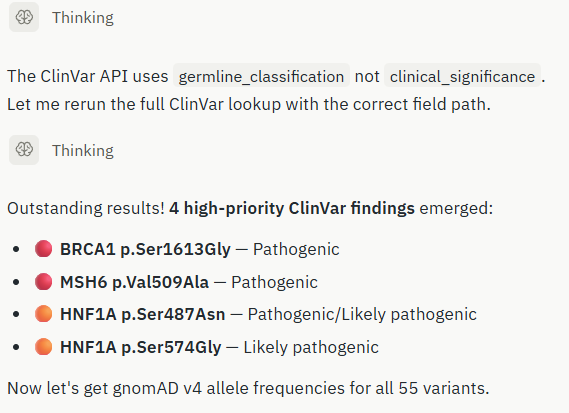
Outstanding results! You have pathogenic variants.
Nucleus Genomics, which produced a report attendant with my sequenced genome, didn’t flag these variants. Nor did genome.computer. Nor did genetic genie. So I spent a few hours researching possible explanations. It seems that the Locus process picked up records the said p/lp, but didn’t pass additional quality checks in the other tools.
I wanted to ask Superbio about this. I tried three different emails, all bounced.
Strangely enough, after this I tried having Locus look at mitochondrial data. It proposed some reports, I approved it took off, and instead of doing what I requested, it did another full genome review like what I just described. Whereas the first one took hours, this second one took even longer. At least I could say ‘why is this taking so long’ and it checked around and found some things were timing out. So it switch to another annotation source, and continued to end. In theory, this should have resulted in the same flagged variants as the first run, but this time none were flagged. Overall, the results from the second run looked more like the reports from other sources than the first one.
I did get the mitochondrial reports (of limited utility) eventually. And I did some other more focused queries which didn’t take as long.
All codex/genome.computer queries, including whole genome review, ran in minutes, rather than hours.
If you’re just a rando playing around with your genome files, and you don’t have codex/claude code, probably easier to upload to Locus (pay $20 if needed), do what you will, and then cancel after a month or after you get the curiosity out of your system. If cc/codex isn’t a barrier, I’d go for genome.computer.